


 Español
 Pусский
 한국어
한국어 中文
中文


Silicone Automation Equipment with Extrusion Equipment
Silicone Automation Equipment with Extrusion Equipment Silicone automation equipment combined with extrusion systems plays a critical role in modern manufacturing, particularly in industries requiring high-precision, durable, and flexible silicone components. These integrated solutions enhance efficiency, consistency, and scalability in production processes, making them indispensable for applications in medical devices, automotive parts, consumer electronics, and more. Key Components and Functionality 1. Extrusion Equipment: - The extrusion system is designed to process silicone rubber into continuous profiles, tubes, seals, or custom shapes. It typically includes a hopper for raw material feeding, a screw-driven barrel for heating and mixing, and a die that shapes the molten silicone. Advanced extrusion systems feature precise temperature and pressure controls to ensure uniform material flow and dimensional accuracy. 2. Automation Integration: - Automated handling systems, such as robotic arms or conveyor belts, are synchronized with extrusion equipment to streamline production. Robots can perform tasks like cutting, sorting, or stacking extruded silicone parts, reducing manual labor and minimizing errors. Vision systems and sensors may be incorporated for real-time quality inspection. 3. Process Control and Monitoring: - Modern silicone automation systems utilize programmable logic controllers (PLCs) and human-machine interfaces (HMIs) to monitor parameters like temperature, speed, and pressure. Data analytics tools enable predictive maintenance, reducing downtime and optimizing output. Advantages - Precision & Consistency: Automation ensures repeatable quality, critical for industries like medical devices where tolerances are stringent. - Efficiency: Continuous operation and reduced waste improve throughput and cost-effectiveness. - Flexibility: Quick die changes and programmable settings allow for rapid transitions between product designs. - Safety: Automated systems minimize human exposure to high-temperature processes or hazardous materials. Applications - Medical: Catheters, gaskets, and seals requiring biocompatibility. - Automotive: Weatherstripping, vibration dampeners, and hoses. - Electronics: Insulation, gaskets, and protective coatings. Future Trends Innovations like AI-driven process optimization and sustainable material handling are shaping the next generation of silicone automation. The integration of IoT-enabled devices further enhances connectivity and smart manufacturing capabilities. By combining extrusion technology with automation, manufacturers achieve superior product quality, operational efficiency, and adaptability to evolving market demands.
Products
Category:
-
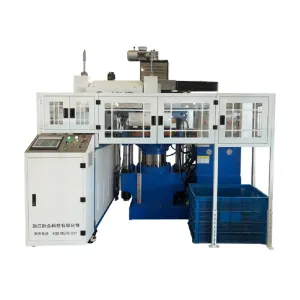
XP (GT200S/GT300S/GT400S) H Cold Feed Single-Unit Type Rubber Automation Equipment
Category: Rubber EquipmentBrowse number: 62Number:Release time: 2025-12-31 10:51:54Equipment Description:Rubber strip raw material is cold-fed into the feeding port. The process includes conveying and plasticizing, rubber blank loading, product vulcanization, product demolding, finished product boxing, and mold cleaning. When integrated with a vulcanizing press, it forms a closed-loop process flow, enabling fully automated production.Application Scope:1. Rubber materials, including Nitrile (NBR), Hydrogenated Nitrile (HNBR), Fluoroelastomer (FKM), Ethylene Propylene Diene Monomer (EPDM), Natural Rubber (NR), Butyl Rubber (IIR), and Recycled Rubber.2. Suitable products: Rubbe...
News
Category:
-
[Industry News]Trends Shaping the Future of Silicone Part Manufacturing
2025-12-27 14:16:22
Case
Category:
No search results found!
Video
Category:

Download
Category:
No search results found!
Job
Category:
No search results found!
Featured Products
No search results found!


