
 Español
 Pусский
 한국어
한국어 中文
中文


Fully Automatic Rubber Products Production Line
Fully Automatic Rubber Products Production Line A fully automatic rubber products production line is an advanced manufacturing system designed to produce a wide range of rubber components with minimal human intervention. This integrated system enhances efficiency, precision, and consistency while reducing labor costs and production time. The production line typically includes raw material processing, mixing, molding, curing, finishing, and quality control stages, all seamlessly connected through automation. 1. Raw Material Handling and Mixing The process begins with automated feeding of raw rubber compounds, fillers, and additives into a high-speed mixer. Computer-controlled systems ensure accurate ingredient ratios, optimizing material properties. The mixed rubber is then transferred to an extruder or calendering machine to form sheets or strips, ready for molding. 2. Molding and Forming Precision molds are used in automated presses (such as injection or compression molding machines) to shape the rubber into the desired product. Robotic arms handle the loading and unloading of molds, ensuring consistent cycle times. The system adjusts temperature and pressure automatically for uniform curing. 3. Curing (Vulcanization) The molded rubber products move through a curing oven or autoclave, where heat and pressure activate cross-linking in the rubber matrix, enhancing durability. Sensors monitor curing parameters in real-time to prevent defects. 4. Finishing and Trimming After curing, robotic systems remove excess flash or burrs using cutting, grinding, or laser trimming. Some lines incorporate automated inspection stations to detect imperfections before proceeding. 5. Quality Control and Packaging Vision systems, laser scanners, and mechanical testers verify dimensional accuracy, tensile strength, and surface quality. Defective products are automatically rejected. Approved items are sorted, counted, and packaged by robotic arms or conveyor systems. Advantages of Full Automation - Higher Productivity: Continuous operation with minimal downtime. - Consistent Quality: Reduced human error ensures uniform product standards. - Cost Efficiency: Lower labor requirements and material waste. - Flexibility: Quick mold changes allow for diverse product ranges. Applications Such production lines are used to manufacture automotive seals, industrial gaskets, medical tubing, footwear soles, and consumer goods. The integration of IoT and AI further enhances predictive maintenance and process optimization. In summary, a fully automatic rubber production line represents the forefront of industrial automation, delivering high-speed, high-quality manufacturing while adapting to modern industry demands.
Products
Category:
-
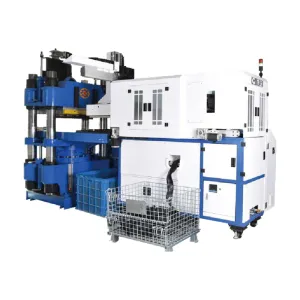
XQ (JQ300S) H Rubber Ring Loading Type Rubber Automation Equipment
Category: Rubber EquipmentBrowse number: 52Number:Release time: 2025-12-31 10:42:43Equipment Description:Rubber strip raw material is cold-fed into the feeding port. The entire process includes conveying and loading, fixed-width cutting, material weighing, product vulcanization, demolding, finished product boxing, and mold cleaning. When integrated with a vulcanizing press, it forms a closed-loop process flow, enabling fully automated production.Application Scope:1. Rubber materials, including Nitrile (NBR), Hydrogenated Nitrile (HNBR), Fluoroelastomer (FKM), Ethylene Propylene Diene Monomer (EPDM), Natural Rubber (NR), Butyl Rubber (IIR), and Recycled Rubber.2. Suitable pro...
News
Category:
-
[Company News]Innovations in Silicone Automation Equipment for Modern Prod...
2025-12-27 13:55:45
Case
Category:
No search results found!
Video
Category:

Download
Category:
No search results found!
Job
Category:
No search results found!
Featured Products
No search results found!


